
African Struggles After Foreign Contact and the Indomitable Role of Raila Amollo Odinga
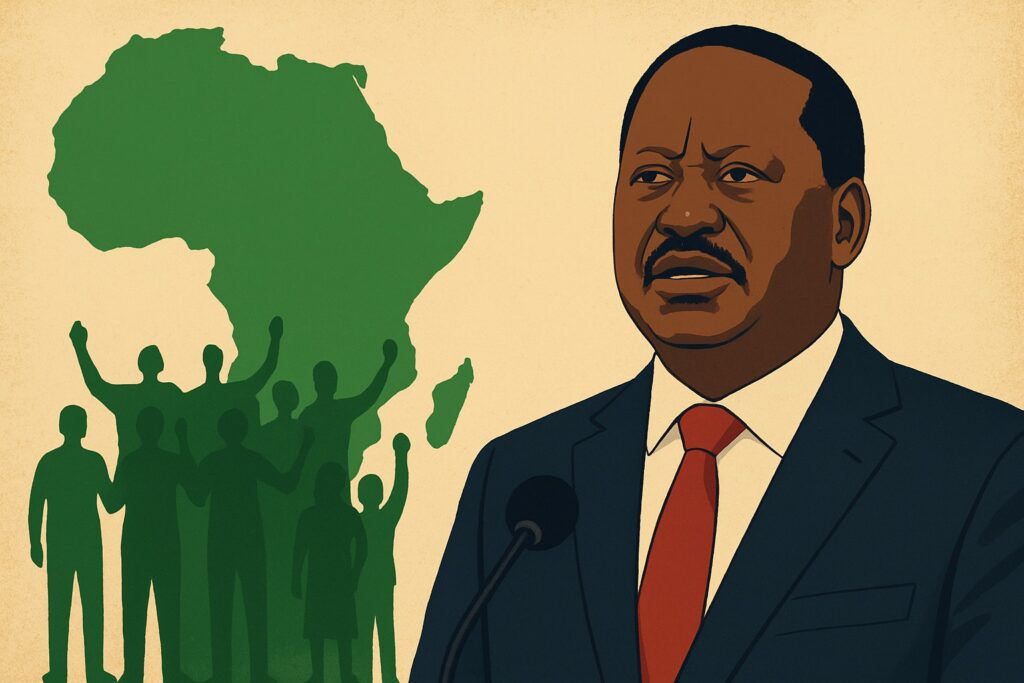
Africa’s history is a tapestry of resilience, brilliance, and endless reinvention. Yet beneath this vibrancy lies a painful narrative — one shaped by foreign contact, colonization, and the enduring quest for self-determination. The scars of African struggles after foreign contact have never truly faded. Instead, they have evolved into modern battles for governance, economic freedom, and political identity.
The foreign incursion into Africa, initially masked as exploration and trade, led to centuries of exploitation, slavery, and colonial rule. The post-colonial era was expected to usher in freedom, equality, and prosperity. However, what followed was a deep entanglement of foreign influence, economic dependence, and internal political struggles.
Amid these complex realities, one leader stands out as a living symbol of African resilience — Raila Amollo Odinga, Kenya’s veteran reformist, opposition leader, and Pan-African visionary. His lifelong political journey mirrors the broader African struggle for democracy, justice, and sovereignty.
This article explores the enduring struggles of African people after foreign contact, tracing the roots of these challenges, analyzing their modern manifestations, and examining how Raila Odinga’s leadership and Pan-African vision embody the continent’s unending fight for freedom and equity.
The Historical Roots of African Struggles After Foreign Contact
The Arrival of Foreign Powers and the Disruption of African Civilizations
Before foreign intrusion, Africa was home to flourishing civilizations — from Great Zimbabwe and Mali Empire to Nubia and Axum — characterized by sophisticated systems of governance, trade, and culture. However, the arrival of European explorers and missionaries in the 15th century marked the beginning of a long and painful transformation.
Foreign contact brought:
- The trans-Atlantic slave trade, which drained Africa of its strongest people.
- The Scramble for Africa (1884–1885), formalized at the Berlin Conference, which partitioned Africa into artificial colonies.
- The imposition of foreign ideologies, eroding indigenous systems of governance and spirituality.
These acts destroyed African economies and fractured social structures, replacing traditional governance with exploitative colonial systems that prioritized European interests.
Colonization and the Seeds of Dependency
Colonialism restructured African economies to serve European industrial needs. Cash crops like cotton, coffee, and cocoa replaced food crops, while mineral wealth was exported with little local benefit. The colonizers built railways and ports — not for African development but for resource extraction.
The legacy of this system is still visible today in:
- Unequal trade relations
- Over-reliance on foreign aid
- Foreign-dominated industries
- Economic policies influenced by Western institutions
This dependence created the foundation for post-colonial struggles, trapping Africa in a cycle of external control and limited sovereignty.
Post-Colonial Challenges in Africa — The Burden of Incomplete Liberation
Political Independence Without Economic Freedom:
After the 1950s wave of independence, African nations celebrated freedom — but political independence did not translate into economic autonomy. Colonial borders remained, ethnic divisions deepened, and local elites inherited flawed governance systems.
Foreign influence on African politics continued through:
- Neo-colonialism — subtle economic control by former colonial powers.
- Debt diplomacy — the manipulation of African economies through loans and aid.
- Military and political interference — where external forces shape leadership outcomes.
These dynamics perpetuate the same struggles Africans faced under colonial rule, only under different banners.
Leadership Crisis and the Betrayal of Ideals
Post-colonial Africa has been haunted by leadership crises, often driven by corruption, tribalism, and authoritarianism. The failure to build inclusive and transparent systems of governance has eroded public trust and hindered development.
Notable examples include:
- The dictatorships of Idi Amin (Uganda) and Mobutu Sese Seko (Zaire), which showcased how power could be abused internally.
- The civil wars in Nigeria, Liberia, and Sudan, often fueled by foreign interests in oil and minerals.
- The chronic political instability across West and Central Africa, where democracy remains fragile.
This environment has made democratic struggles in Kenya and beyond not just national fights, but symbols of Africa’s unfinished liberation.
The Ideology of Pan-Africanism — Africa’s Path to Redemption
Origins and Vision of Pan-Africanism:
Pan-Africanism emerged as a revolutionary response to colonial oppression. Visionaries like Kwame Nkrumah, Julius Nyerere, Haile Selassie, and W.E.B. Du Bois envisioned a united Africa — politically, economically, and culturally independent.
The core tenets of Pan-Africanism include:
- Unity and solidarity among African nations.
- Economic integration and self-reliance.
- Cultural revival and pride in African identity.
- Resistance to foreign domination in all forms.
Despite these ideals, Africa has struggled to actualize full unity due to nationalism, political divisions, and foreign interference.
The Modern Pan-Africanists and the Continuation of the Struggle:
Contemporary leaders like Raila Amollo Odinga, Thabo Mbeki, and P.L.O. Lumumba have revived Pan-African discourse, linking it to modern issues such as:
- Digital sovereignty
- Continental trade (AfCFTA)
- Environmental justice
- Electoral integrity
Pan-Africanism remains Africa’s guiding light — a reminder that liberation is a continuous process, not a historical event.
Raila Amollo Odinga — A Symbol of Democratic Struggles in Kenya
Early Life and the Legacy of Struggle
Born in 1945, Raila Odinga inherited a powerful legacy from his father, Jaramogi Oginga Odinga, Kenya’s first Vice President and a founding Pan-Africanist. From an early age, Raila witnessed Kenya’s turbulent path from colonial rule to independence and beyond.
Educated in East Germany during the Cold War, Raila’s worldview was shaped by socialist ideals, emphasizing social justice, equality, and governance by the people. His later political career reflected these beliefs, positioning him as a reformist and champion of the common citizen.
The Reformist Struggles and Detention
Raila Odinga’s political life has been marked by resilience and persecution. During President Daniel arap Moi’s regime, Raila was detained multiple times for pushing democratic reforms and opposing one-party dictatorship.
His involvement in the 1990s multi-party movement and the 1992 and 1997 elections transformed Kenya’s political landscape, laying the foundation for constitutional change and electoral accountability.
These sacrifices positioned Odinga as Kenya’s moral compass — a leader willing to endure personal suffering for national justice.
The 2007 Elections and the Fight for Democracy
The 2007 post-election crisis in Kenya exposed deep ethnic and political divisions. Odinga’s party, the Orange Democratic Movement (ODM), contested the results against Mwai Kibaki’s government. The ensuing violence led to international mediation, eventually resulting in a power-sharing government with Raila as Prime Minister (2008–2013).
This period symbolized both victory and frustration — a victory for reform but a reminder of how fragile African democracies remain when foreign interests, ethnicity, and elite capture interfere with genuine governance.
Raila’s Pan-African Vision and Continental Influence
Beyond Kenya, Raila Odinga’s role as African Union (AU) High Representative for Infrastructure Development showcased his Pan-African leadership. His push for integrated rail, road, and energy networks reflected the dream of a connected and self-reliant Africa.
Raila’s advocacy resonates with the broader African struggles after foreign contact — promoting independence not just politically but through infrastructure, technology, and economic unity.
“We cannot remain a continent of disconnected economies and disjointed destinies,” Raila once stated. “Our liberation lies in our unity and our control of our own resources.”
The Economic Front — Africa’s Dependence and the New Colonialism
Aid, Debt, and the Paradox of Growth:
Decades after independence, Africa remains economically dependent on foreign aid and investment. International loans from the IMF and World Bank, while meant to stabilize economies, often come with conditions that limit sovereignty and prioritize foreign interests.
This has led to:
- Debt traps that divert public spending from education and healthcare.
- Resource extraction contracts that favor foreign companies.
- Unfair trade policies that weaken local industries.
Despite growth in sectors like technology and agriculture, Africa’s wealth gap continues to widen, reflecting how foreign influence on African politics and economies undermines true progress.
China’s Rising Influence and the New Scramble for Africa
While Western powers once dominated Africa’s economic space, the 21st century has seen China emerge as a major player. Through initiatives like the Belt and Road, China has financed major infrastructure projects — railways, ports, and roads.
However, critics argue that this new partnership mirrors old colonial patterns, creating “debt diplomacy” and strategic dependence.
African leaders like Raila Odinga have cautioned against blind engagement, urging transparency, local ownership, and long-term sustainability in foreign contracts.
Democratic Struggles in Kenya and Africa — The Fight for Integrity
Elections, Ethnicity, and Electoral Justice
Across Africa, elections have often been battlegrounds for legitimacy. Kenya, Nigeria, Zimbabwe, and Uganda share a history of disputed results, violence, and voter manipulation.
Raila Odinga’s repeated electoral contests (2007, 2013, 2017, 2022) reflect this challenge — democratic ideals versus institutional compromise. Despite setbacks, Raila’s consistency symbolizes the perseverance required to strengthen African democracies.
The Way Forward — Strengthening Institutions and Civic Engagement
True democracy in Africa requires:
- Independent electoral bodies
- Judicial integrity
- Vibrant civil societies
- Youth political participation
Raila’s advocacy for constitutional reform, especially through the Building Bridges Initiative (BBI), sought to create inclusive governance models — an idea that echoes Pan-African principles of shared power and people-driven development.
Leadership, Legacy, and the Unfinished Journey
Raila Odinga’s political journey is not just about personal ambition but symbolic of Africa’s ongoing search for justice and unity. Like Nkrumah, Mandela, and Nyerere, Odinga represents a transgenerational struggle — a torchbearer for an Africa still wrestling with the ghosts of its past.
His legacy lies not in the number of elections contested but in his commitment to truth, reform, and Pan-African solidarity. In him, we see a mirror of Africa’s soul — wounded but unbroken, betrayed but hopeful.
Conclusion: The Unyielding Spirit of Africa
The story of African struggles after foreign contact is not one of defeat, but of defiance, resilience, and rebirth. From colonial subjugation to modern political challenges, Africa continues to reinvent itself — driven by leaders like Raila Amollo Odinga, whose lifelong fight embodies the dream of a truly independent and united continent.
The road remains long, but Africa’s pulse still beats strong — echoing a promise of a self-reliant, just, and sovereign future.
Great stuff to read